
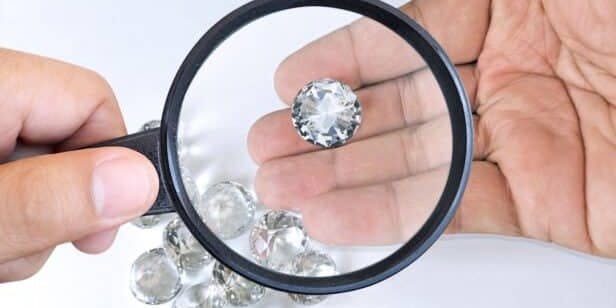
Not sure whether your diamond jewelry is real or fake? It’s always better to be safe when you’re investing a lot of money into diamond jewelry! Diamond engagement rings in Vancouver have symbolized eternal bonds and commitment for ages. When you know how to check for a fake diamond, your mind will feel reassured about your investment! In this blog, we will share how to check if a diamond is real at home so that you can spot a fake diamond easily.
By knowing how to check whether a diamond is real or not at home, you can save a lot of precious time and money. In this guide, we’ll explore different ways to test whether your diamond jewelry, such as Lab Grown Engagement Rings Vancouver is genuine and authentic.
Keep in mind that the best way to ensure whether your diamond jewelry is real or not is by consulting a professional gemologist. They have advanced diamond testers which helps them find out whether your diamond is 100%. Even if you don’t want to go visit a professional gemologist, don’t worry! The methods we’re about to share can help you easily check if the diamond is real or just a fake stone.
Whether you need to check the authenticity of your custom wedding rings Vancouver or other pieces of jewelry, keep reading the following sections to find out more about real diamonds, the meaning of diamond stimulants, and 10 easy at-home test methods to help tell if your diamond is real.
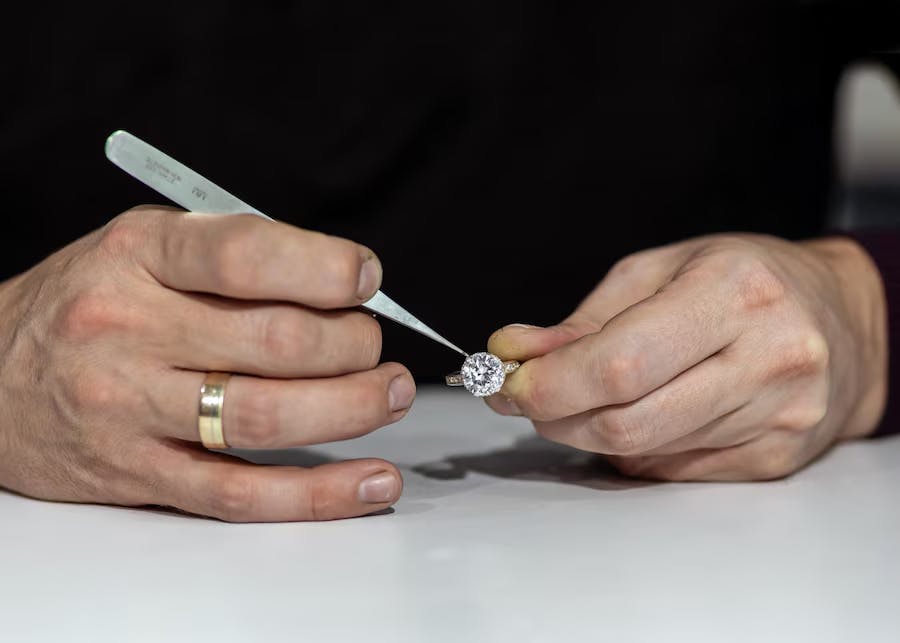
How To Tell if a Diamond is a Fake Diamond at Home?
There are certain physical as well as chemical properties found in diamonds that are not found in any other gemstones. One such property of diamonds is their hardness, along with an exceedingly high refractive index, as well as sharp edges on the stones. Usually, a genuine diamond, however, is found to contain certain inclusions that would be non-existent in a fake diamond because these are special imperfections that are not visible to the naked eye.
Both kinds of diamonds are real, whether grown in a lab or found in nature. You will also come across diamond simulants, which can be referred to as imitation diamond jewelry. Although it is not always easy to tell, one can identify a real diamond using simple at-home tests, as we will see in the next section. Now you will be able to do the test using household items as well and will know whether the stone is fake or not. To buy real and quality diamonds, visit diamond stores Vancouver that have professional gemologists. For now, let’s learn these methods!
What are Diamond Simulants?
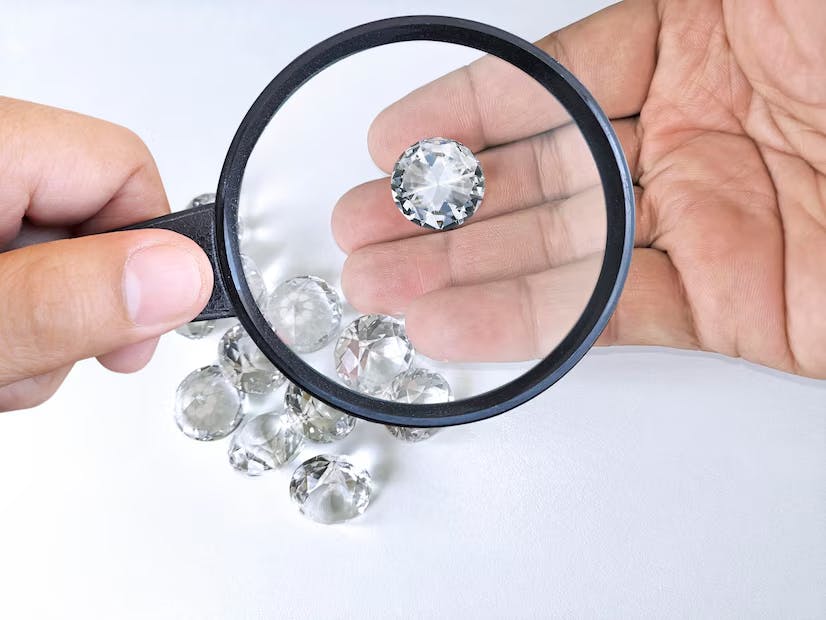
Look-alike stones that replicate the physical appearance of diamonds but have different physical and chemical properties are known as Diamond Simulants. For example, white sapphire, cubic zirconia (CZ), white topaz, and moissanite are some very commonly found diamond simulants. Testing can easily differentiate between these diamond simulants and fake ones.
How to Tell the Difference: Real Diamond or Diamond Simulant?
Diamond simulants may be indistinguishable from the naked eye from a real diamond, yet at times, they fail to give the same bright sparkle. You can carry out a sparkle test to judge your diamond without the use of any special instruments; just by observing whether it has bright white light reflections. If the sparkle is colored too much or muted, chances are that you have a diamond simulant.
You can also use other tests like the sunlight test, water test, and fog test to check if the diamond is a real diamond or a diamond simulant. This will also let you know if your diamond is fake.
How Are Diamond Jewelry Certified?
You can ascertain whether or not a diamond is genuine by checking its certification. Reputed organizations such as GIA have proper systems in place for certifying whether a diamond is real. They also provide you with very valuable details on the diamond based on the 4Cs. Some of the most reputed diamond certification organizations include:
1. Certification by GIA
The Gemological Institute of America (GIA is the most trustworthy institution for diamond grading. It has been certifying diamonds since the 1930s and is considered one of the originators of the diamond grading system.
2. Certification by AGS
The American Gem Society (AGS also began certifying diamonds in the 1930s, just as the GIA did. They grade diamonds on a scale of 0-10, with 0 being the best and 10 the worst.
3. Certification by IGI
IGI, or the International Gemological Institute (IGI), is another reputable institution that grades diamonds around the world. It mostly certifies diamonds in Europe and Asia and is less known in Canada and the US.
If you want to buy diamond jewelry such as a diamond ring, and want to know whether the ring is real, we advise you to ask the store for the certification. A diamond certification comes with a detailed report explaining the 4Cs of the diamond. It also helps you confirm whether the stone is real or not.
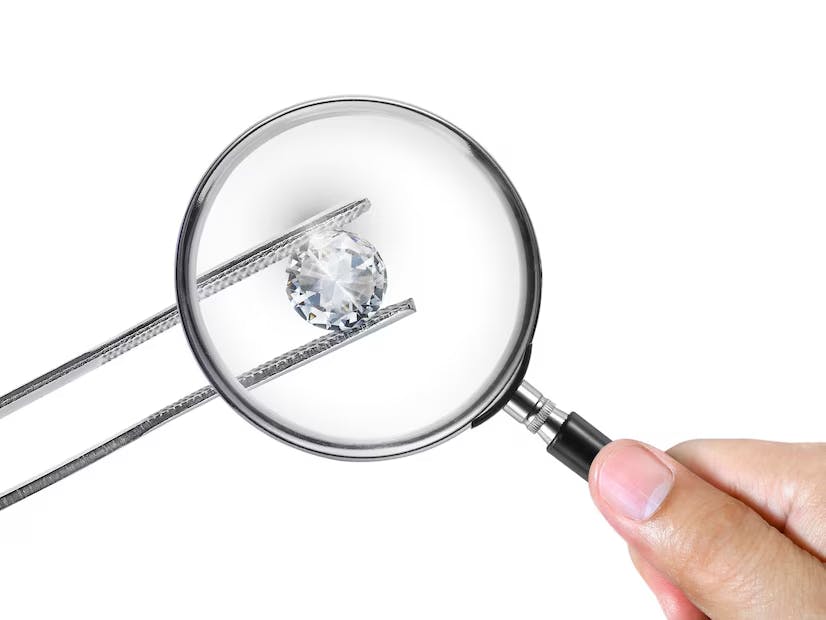
How to Tell if a Diamond is Real or Fake: 10 Safe At-Home Tests
These tests can be used to tell whether the diamond is real or not. However, the best recommendation is to visit a diamond store to verify whether a diamond is real. Let us now go through each test:
1. Water Test
If you have a loose diamond, drop it gently into a glass of water. Real diamonds sink to the bottom due to their high density. If the stone stays floating and does not sink to the bottom, it is most likely not a real diamond.
2. Fog Test
With the diamond held in two fingers, breathe on it. If it’s a genuine diamond, then the fog will disappear immediately. If the fog stays, then it could be a diamond simulant.
3. Sunlight Test
You should hold your diamond under sunlight and observe how it reflects that light. A real diamond will reflect white light and will have a little rainbow color to it but will sparkle magnificently. A diamond simulant, meanwhile, would have a reflection that is too colorful.
4. Flashlight Test
You should shine a flashlight straight into your diamond, in a dark room. Real diamonds reflect white light brilliantly. But, a diamond simulant will not reflect white light with the same brilliant intensity as true diamonds.
5. Dot Test
Next, draw a small black dot on a white piece of paper, and place the diamond on it. If you see the dot without difficulty, it is fake. If it’s a true diamond, you won’t be able to see that dot.
6. UV Light Test
You should know that a diamond emits light under a UV lamp, with the effect of a blue glow, so it is definitely a real diamond. However, there are some diamonds that won’t glow, even if the diamond is real. Therefore, it is better to get your diamonds checked by a professional. If it glows, then it would surely be a real diamond.
7. Mirror Test
Position the diamond before a mirror. A real diamond would reflect bright white light intensely while a fake diamond would not be able to reflect bright light with the same intensity.
8. Heat Test
Heat up the diamond for 40 seconds with a lighter and after you do it, gently sink it in a cold glass of water. Real diamonds do not crack, nor do they shatter, at sudden temperature changes. A fake diamond may crack or shatter immediately.
9. Weight Test
Real diamonds are less dense than diamond simulants. If the weight of your diamond is different from its cut and size, then there are chances it is not real.
10. Newspaper Test
To perform this, place the diamond on a newspaper. If the diamond is real, it would be impossible to read through the diamond’s surface due to its high reflective index. If it’s not a diamond, however, it would be easily read through the content.
Final Thoughts
Though these at-home tests assist in diagnosing whether a diamond is genuine, they will not provide a 100% accurate answer. If still in doubt, the best way to confirm your diamond’s authenticity would be to see a gemologist from a trusted diamond store. They will be competent enough to determine whether the diamond is real or fake by using professional tools.
Discover the Timeless Elegance of Real Diamonds
Browse our exclusive collection. Every diamond at our store has been certified by reputable institutions.